
Cháng’ān (長安 « Paix éternelle ») fut l’une des plus importantes capitales de l’histoire de la Chine impériale et l’un des plus grands centres urbains du monde prémoderne. Située à proximité de l’actuelle ville de Xī’ān (西安), elle servit notamment de capitale aux dynasties des Hàn occidentaux (西漢, Xī Hàn), puis des Suí (隋) et surtout des Táng (唐). Sous…Lire la suiteCháng’ān

Pantopique : continent
Les continents, ces vastes étendues de terre qui constituent les bases physiques de notre planète, suscitent une multitude de questions sur leur formation, leur diversité culturelle et géographique, ainsi que leur impact sur la vie humaine. Comment les continents ont-ils émergé au cours de l’histoire géologique de la Terre, et quelles forces naturelles ont sculpté leur topographie variée, des montagnes majestueuses aux vastes plaines et aux côtes accidentées ? Comment les continents ont-ils servi de berceaux à des civilisations anciennes, chacun développant des cultures uniques, des langues et des modes de vie adaptés à leurs environnements spécifiques ? Comment a-t-on nommé les continents ? Comment les mouvements migratoires ont-ils façonné la diversité humaine à travers les continents, créant des liens complexes entre les peuples et générant des échanges culturels riches et variés ? Quelles sont les conséquences actuelles des divisions continentales sur les plans politiques, économiques et environnementaux, et comment les continents interagissent-ils dans un monde de plus en plus interconnecté ? Comment les récits et les légendes, empreints de l’identité propre à chaque continent, ont-ils influencé les perspectives culturelles et spirituelles des populations qui les habitent ? Comment les défis environnementaux actuels, tels que le changement climatique et la perte de biodiversité, affectent-ils les continents de manière différenciée, et quelles solutions globales peuvent être envisagées pour préserver l’équilibre écologique ?…
Un pantopique correspond à la réunion de quelques repères, plus ou moins nombreux, que vous pouvez commenter, compléter, étendre, selon vos propres champs d’expériences, de savoirs, d’enquêtes… - contact@21dialogues21.org
La bataille de Shigisan (信貴山の戦い, Shigisan no Tatakai), également appelée bataille du mont Shigi (信貴山, Shigisan), constitue l’un des événements les plus importants de la période d’Asuka (飛鳥時代, Asuka jidai). Elle se déroula en 587 dans la région de Shigisan, à la frontière des actuelles préfectures de Nara et d’Osaka. Cet affrontement opposa principalement le clan Soga (蘇我氏, Soga-shi), dirigé…Lire la suiteBataille de Shigisan
Mononobe no Moriya (物部守屋) fut le chef du clan Mononobe (物部氏, Mononobe-shi) et porta le titre d’Ō-muraji (大連), l’une des plus hautes dignités de l’État de Yamato. Héritier d’une famille traditionnellement chargée des fonctions militaires et rituelles, il devint la principale figure de l’opposition à l’introduction du bouddhisme au Japon. Les Mononobe considéraient en effet les cultes autochtones des kami…Lire la suiteMononobe no Moriya
Le Shoku Nihongi (続日本紀 « Suite des Chroniques du Japon ») est l’une des principales chroniques historiques officielles du Japon ancien. Il constitue le deuxième ouvrage des Six Histoires Nationales (Rikkokushi, 六国史), ensemble de chroniques commandées par la cour impériale. Compilé en 797 sous le règne de l’empereur Kanmu (桓武天皇, Kanmu Tennō), il poursuit le récit historique commencé dans le…Lire la suiteShoku Nihongi
L’empereur Yōmei (用明天皇, Yōmei Tennō) fut le trente et unième souverain du Japon selon la tradition impériale. Né en 540, il était le fils de l’empereur Kimmei (欽明天皇, Kimmei Tennō) et le père du futur prince Shōtoku (聖徳太子, Shōtoku Taishi). Son règne fut très bref, s’étendant de 585 à 587, mais il se déroula à une période cruciale de l’histoire…Lire la suiteEmpereur Yōmei
L’école Sanron (三論宗, Sanron-shū en japonais ; chinois 三論宗, Sānlùn-zōng, « École des Trois Traités ») constitue la forme est-asiatique de la philosophie Madhyamaka (skt. मध्यमक « Voie moyenne »), fondée en Inde par le philosophe Nāgārjuna (skt. नागार्जुन ; jap. 龍樹, Ryūju), actif vers le IIe siècle. Son nom dérive de trois textes fondamentaux : le Traité du Milieu…Lire la suiteEcole Sanron
Le prince Shōtoku (聖徳太子, Shōtoku Taishi), également connu sous le nom de Umayado no Ōji (厩戸皇子), est l’une des personnalités les plus célèbres de l’histoire japonaise. Né en 574, il était le fils de l’empereur Yōmei (用明天皇, Yōmei Tennō) et le neveu de l’impératrice Suiko (推古天皇, Suiko Tennō). Nommé régent en 593, il joua un rôle central dans le gouvernement…Lire la suiteShōtoku Taishi
L’impératrice Suiko (推古天皇, Suiko Tennō) fut la trente-troisième souveraine selon la tradition impériale japonaise et la première femme à accéder officiellement au trône du Japon. Née en 554 sous le nom de Nukatabe-hime (額田部皇女, Nukatabe no Himemiko), elle appartenait à la dynastie de Yamato et était la fille de l’empereur Kimmei (欽明天皇, Kimmei Tennō). Elle monta sur le trône en…Lire la suiteImpératrice Suiko
Soga no Umako (蘇我馬子) fut l’un des hommes d’État les plus influents de la période d’Asuka. Membre du puissant clan Soga (蘇我氏, Soga-shi), il joua un rôle déterminant dans la diffusion du bouddhisme et dans la transformation politique du Japon ancien. Héritier d’une famille favorable aux relations avec le continent, il poursuivit la politique de son père Soga no Iname…Lire la suiteSoga no Umako
Heijō-kyō (平城京), parfois désignée sous la lecture alternative Heizei-kyō, fut la capitale impériale du Japon de 710 à 784. Elle correspond à l’actuelle ville de Nara (奈良, Nara), dont elle constitue le noyau historique. Son établissement marque le début de la période de Nara (奈良時代, Nara jidai). La ville fut conçue selon un plan en damier inspiré de Cháng’ān (長安),…Lire la suiteHeijō-kyō
Tori Busshi (止利仏師), également appelé Kuratsukuri Tori (鞍作止利, « Tori le fabricant de selles »), fut le plus célèbre sculpteur bouddhique du Japon des VIe et VIIe siècles. Actif sous les règnes des souverains de la période d’Asuka, il appartenait à une famille d’artisans d’origine continentale installée à la cour de Yamato. Son grand-père aurait été un immigrant venu de…Lire la suiteTori Busshi
Le Kōryū-ji (広隆寺), situé dans le quartier d’Uzumasa (太秦) à Kyoto, est l’un des plus anciens temples bouddhiques du Japon. Selon la tradition, il fut fondé en 603 par le clan Hata (秦氏, Hata-shi), groupe d’immigrants d’origine continentale installé dans la région du Kinai. Le temple est étroitement associé à la mémoire du prince Shōtoku (聖徳太子, Shōtoku Taishi), auquel il…Lire la suiteKōryū-ji
Goguryeo (고구려, Goguryeo ; hanja 高句麗) fut le plus vaste et le plus septentrional des Trois Royaumes de Corée. Fondé traditionnellement en 37 av. J.-C., il occupait un territoire couvrant une grande partie du nord de la péninsule coréenne ainsi que certaines régions de la Mandchourie. Grâce à sa puissance militaire, Goguryeo s’imposa comme l’un des principaux États d’Asie du…Lire la suiteGoguryeo
La période Yayoi (弥生時代, Yayoi jidai) correspond à une phase de la préhistoire japonaise généralement située entre le Ve siècle av. J.-C. et le IIIe siècle apr. J.-C., bien que sa chronologie fasse encore l’objet de débats. Son nom provient du quartier de Yayoi (弥生) à Tokyo, où furent découverts à la fin du XIXe siècle des vestiges caractéristiques de…Lire la suitePériode Yayoi
Le royaume de Silla (신라 | 新羅) fut l’un des Trois Royaumes de Corée (Samguk, 삼국, 三國), aux côtés de Baekje (백제, 百濟) et de Goguryeo (고구려, 高句麗). Fondé traditionnellement en 57 av. J.-C. dans le sud-est de la péninsule coréenne, il connut une expansion progressive qui en fit l’une des principales puissances de l’Asie orientale. À partir du VIe…Lire la suiteRoyaume de Silla
La période Yamato (大和時代, Yamato jidai) désigne la longue phase de l’histoire ancienne du Japon au cours de laquelle le pouvoir fut progressivement concentré autour de la cour de Yamato, située dans l’actuelle préfecture de Nara. Elle couvre approximativement les années 250 à 710 et englobe généralement la période Kofun (古墳時代, Kofun jidai) et la période d’Asuka (飛鳥時代, Asuka jidai).…Lire la suitePériode Yamato
Baekje (백제 | 百濟 ; jap. Kudara, 百済) fut l’un des Trois Royaumes de Corée (Samguk, 삼국, 三國), aux côtés de Goguryeo (고구려, 高句麗) et de Silla (신라, 新羅). Fondé traditionnellement en 18 av. J.-C., il occupait principalement la partie sud-ouest de la péninsule coréenne. Grâce à sa position maritime privilégiée, Baekje développa d’importants échanges avec la Chine et le…Lire la suiteBaekje
L’époque de Nara (奈良時代, Nara jidai) couvre la période comprise entre 710 et 794, lorsque la capitale du Japon fut installée à Heijō-kyō (平城京), l’actuelle ville de Nara (奈良). Cette période marque l’aboutissement des réformes politiques entreprises à l’époque d’Asuka et la mise en place d’un État fortement inspiré des modèles administratifs chinois. La capitale fut conçue selon un plan…Lire la suiteEpoque de Nara
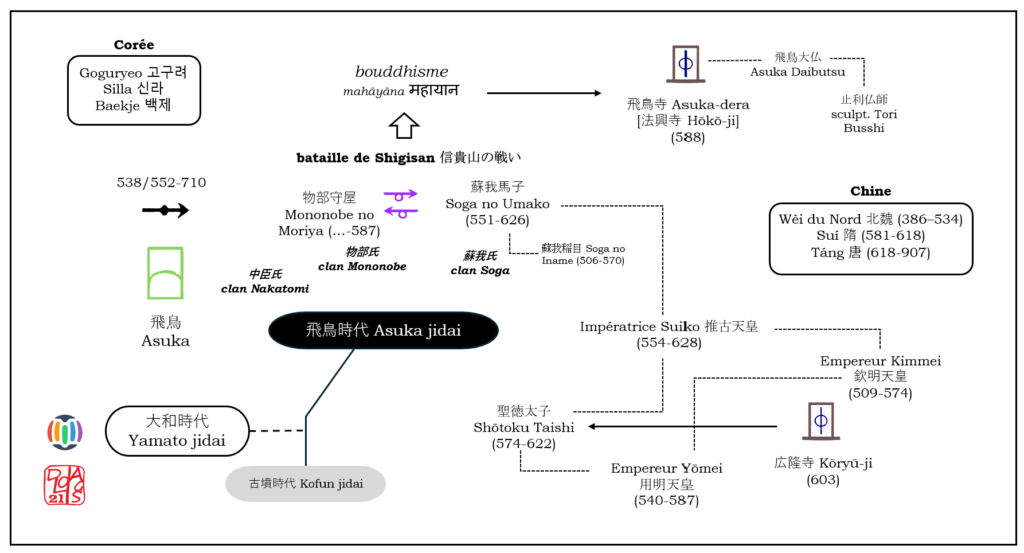
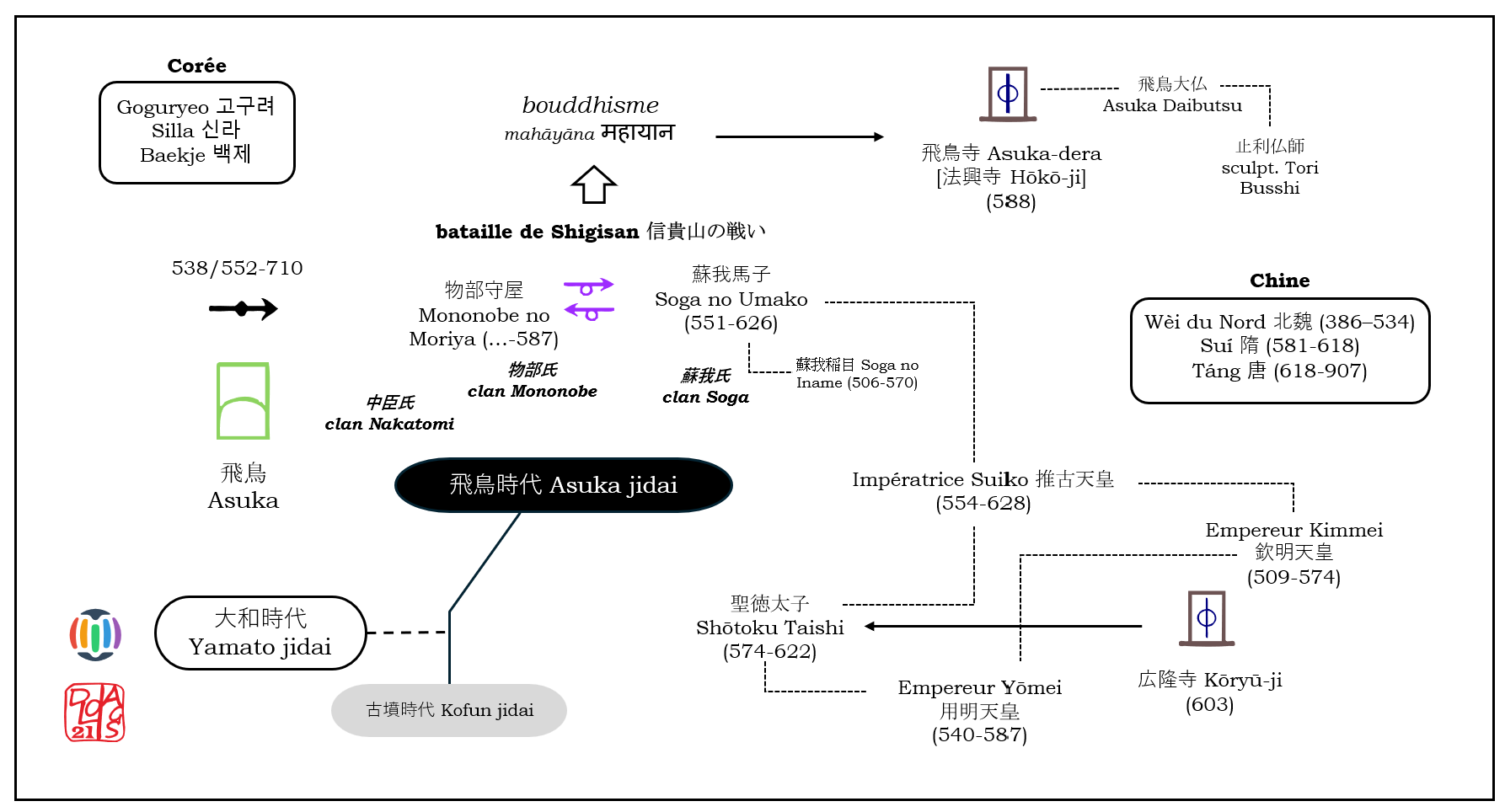
La période d’Asuka (飛鳥時代, Asuka jidai) désigne une phase de l’histoire japonaise s’étendant approximativement de 538 ou 552 à 710. Elle tire son nom de la région d’Asuka (飛鳥, Asuka), située dans l’ancienne province de Yamato (大和国, Yamato no kuni), où résidaient les souverains japonais de l’époque. Cette période est principalement caractérisée par l’introduction et l’enracinement progressif du bouddhisme (仏教,…Lire la suitePériode d’Asuka
Le temple Asuka-dera (飛鳥寺), également connu sous le nom de Hōkō-ji 法興寺, « Temple de la prospérité de la Loi bouddhique »), est considéré comme le premier grand temple bouddhique officiellement établi au Japon. Situé dans la région d’Asuka (飛鳥), au cœur de l’actuelle préfecture de Nara, il fut fondé à la fin du VIe siècle sous le patronage du…Lire la suiteAsuka-dera