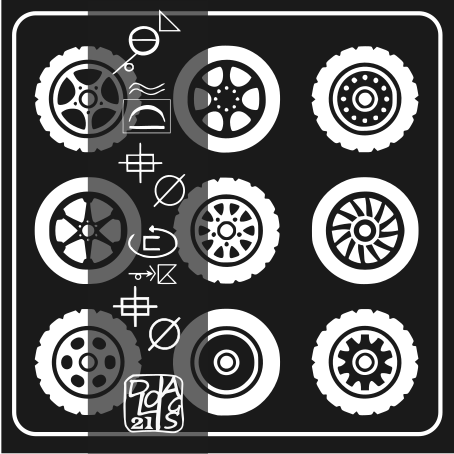
A tire is a rubber ring mounted around a wheel to provide contact between the vehicle and the ground. Its main functions are to support the vehicle’s weight, provide traction, transmit braking and acceleration forces, and absorb some of the road’s unevenness. The invention of the pneumatic tire dates back to 1845, when Robert William Thomson filed a patent for a wheel equipped with an air-filled casing. However, this innovation saw little use until 1888, when John Boyd Dunlop developed an inflatable tire for bicycles. The success of this invention led to its adoption on early automobiles. In 1891, Michelin developed the removable tire, making it easier to replace and repair. Throughout the 20th century, tires underwent numerous advancements thanks to the use of new materials, the introduction of the radial tire, and improvements in manufacturing processes. Today, they offer better traction, longer life, reduced fuel consumption, and enhanced safety. Current research focuses on tires that are more environmentally friendly, connected, and adapted to new transportation technologies.Lire la suitepneu
Vous pouvez compléter, modifier, améliorer cette indéfinition ou en proposer une autre au regard de vos savoirs, langages, pratiques, histoire… qu’elle soit formulée sur un mode scientifique, culturel, poétique… contact@21dialogues21.org