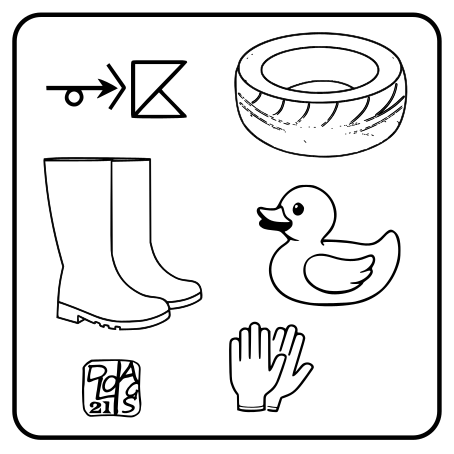
Rubber is an elastic material capable of returning to its original shape after being stretched, compressed, or deformed. It is obtained either from natural latex produced by certain trees, notably Hevea brasiliensis, or through chemical synthesis from petroleum derivatives. The peoples of Central and South America were already using latex long before the arrival of Europeans to make waterproof objects and play balls. In the 19th century, rubber became a major industrial material thanks to its flexibility, elasticity, and water resistance. Its development was greatly advanced by Charles Goodyear’s invention of vulcanization in 1839. This process involves heating rubber with sulfur to improve its strength and durability. Rubber is used today in many fields, including the manufacture of tires, gaskets, belts, gloves, and soles. It plays an essential role in transportation, industry, and daily life. Thanks to its versatility and mechanical properties, rubber remains one of the most important materials of the modern era.Lire la suitecaoutchouc
Vous pouvez compléter, modifier, améliorer cette indéfinition ou en proposer une autre au regard de vos savoirs, langages, pratiques, histoire… qu’elle soit formulée sur un mode scientifique, culturel, poétique… contact@21dialogues21.org