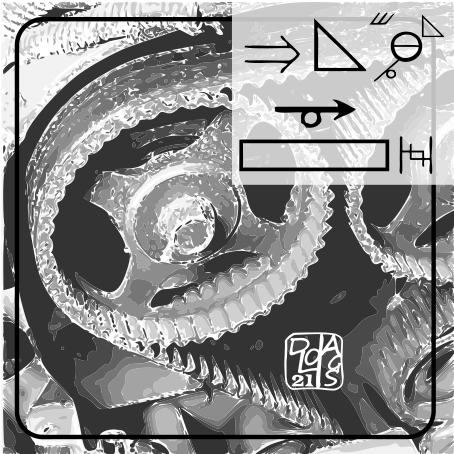
A belt is a flexible strip, formerly made of leather or reinforced fabric, and today most often made of rubber or synthetic materials. It is used to transmit motion and mechanical power between two or more wheels, pulleys, or drive shafts. Its principle relies on the friction between the belt and the components it connects, thereby enabling the transfer of energy from one mechanism to another. In the 19th century, with the development of industry, belts played an essential role in factories: vast transmission networks distributed the energy produced by a central machine—often a steam engine—to all the workshops and production machines. Thanks to this system, motion could be conveyed over long distances within a building and simultaneously power numerous pieces of equipment. The belt is thus a fundamental element in the history of mechanization and industrial organization. Its operation illustrates the combination of flexibility and rotation, of connection and movement, allowing energy to be transmitted efficiently while absorbing certain vibrations and irregularities. Even today, belts are widely used in engines, industrial machinery, and numerous mechanical devices, attesting to the simplicity and enduring efficiency of this device.Lire la suitecourroie
Vous pouvez compléter, modifier, améliorer cette indéfinition ou en proposer une autre au regard de vos savoirs, langages, pratiques, histoire… qu’elle soit formulée sur un mode scientifique, culturel, poétique… contact@21dialogues21.org